CPC students, staff help judge legal-studies event

By Arsenio Humphrey
Knightly News Reporter
PHILADELPHIA – Some Central Penn students and staff were on hand recently at the University of Pennsylvania to help judge the school’s annual undergraduate moot court competition.
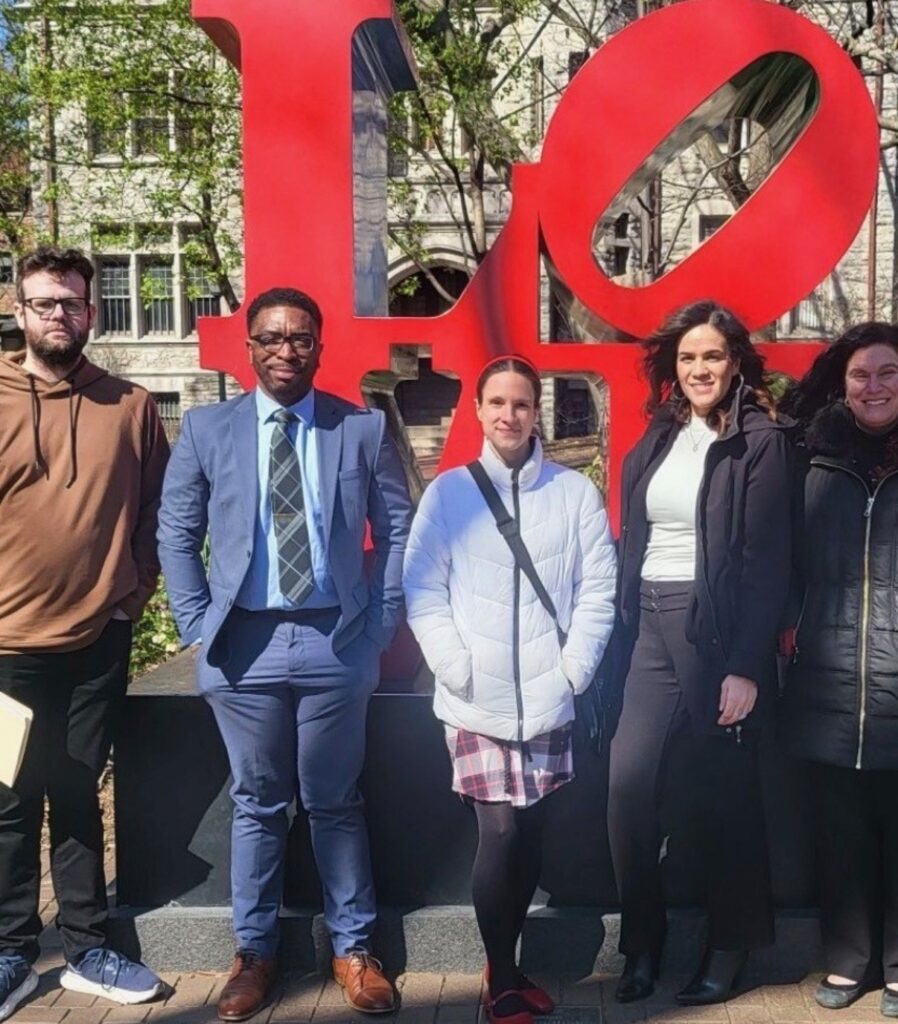
Debate Team members Jared Gander and Arsenio Humphrey (this reporter) and legal-studies major Kacie Gonzalez traveled to Philly between the winter and spring terms with adjunct professor Rachael Baturin and library director Margret Schachte to help score student competitors at a moot-court competition who argued a fictional case, DeNolf v. State of Olympus, that holds real constitutional questions.
In the case, William DeNolf was convicted of murder, based partly on a brain scan that pulled data from his mind. Prosecutors alleged that the information proved he had been at the crime scene. DeNolf was then sentenced to 30 years, in near total solitary confinement, spending almost all his time in a small windowless cell with nearly no human contact.
Competitors tackled two big issues before a mock U.S. Supreme Court:
- Can the government force someone to undergo a brain scan without violating the right against self-incrimination under the Fifth Amendment?
- Does keeping someone in isolation for decades cross the line into cruel and unusual punishment, which is a violation of the Eighth Amendment?
Even though the case was fictional, the concerns are real. As brain technology becomes more advanced and debates about prison conditions continue, cases like DeNolf highlight legal questions the U.S. Supreme Court may have to answer at some point.
The event—The University of Pennsylvania Annual Moot Court Competition—involved 32 teams, with two students per team. Proceedings ran smoothly across four rounds of arguments. Teams were matched randomly, with rules ensuring they didn’t face a team from its own school—some schools entered more than one team—or face the same opponents twice. Students from Penn, Temple, Georgetown, Harvard, Princeton, Dartmouth, Amherst, George Washington and UNC Charlotte competed.
Winners were decided based on overall performance and individual speaking scores that rewarded teamwork and strong advocacy.
DeNolf won his appeal, with the Penn team representing the fictional petitioner. Penn’s prize was formal recognition for winning, with the students receiving a certificate of placement. Notice of the victory will be published.
Central Penn’s attendees said the experience meant more than just attending. For a small college in Enola, having students and faculty serve as judges alongside competitors from schools such as Harvard, Princeton and Dartmouth offered a glimpse of how larger institutions’ programs operate.
‘It was great getting to see the moot court competition in person and to be part of such a supportive and engaged group, Gonzalez said. “Being there made the learning experience feel more real and interactive, and I’m grateful I had the chance to participate.
The Central Penn employees enjoyed the experience, too.
“I had a wonderful time!” Schachte said. “This was my first time participating in a moot court, and I was impressed by how knowledgeable and prepared the students were.”
The Debate Team is open to all Central Penn students with an interest in law, business, professionalism, advocacy and justice. Contact Professor Harry Baturin at [email protected] for more information.
Professor Harry Baturin contributed reporting to this story.
Comments or story ideas? Contact [email protected]
Edited by media-club co-advisor, and this blog’s editor, Professor Michael Lear-Olimpi.