
Breaking the first rule of “Fight Club”
1999 classic is the 30th edition of the CPC Film Series

By Alex Foley
CPC Film Series Correspondent
The first rule of Fight Club is, “You do not talk about Fight Club.”
On the night of Feb. 27, the CPC Film Series broke that rule by hosting a screening of “Fight Club” in the Capital BlueCross Theatre.
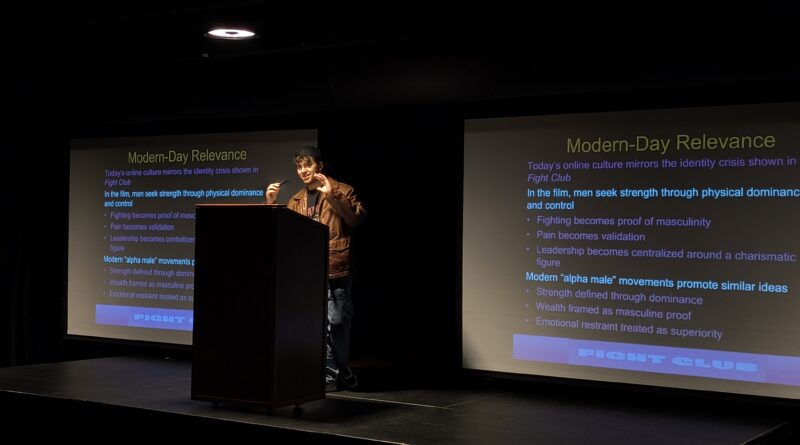
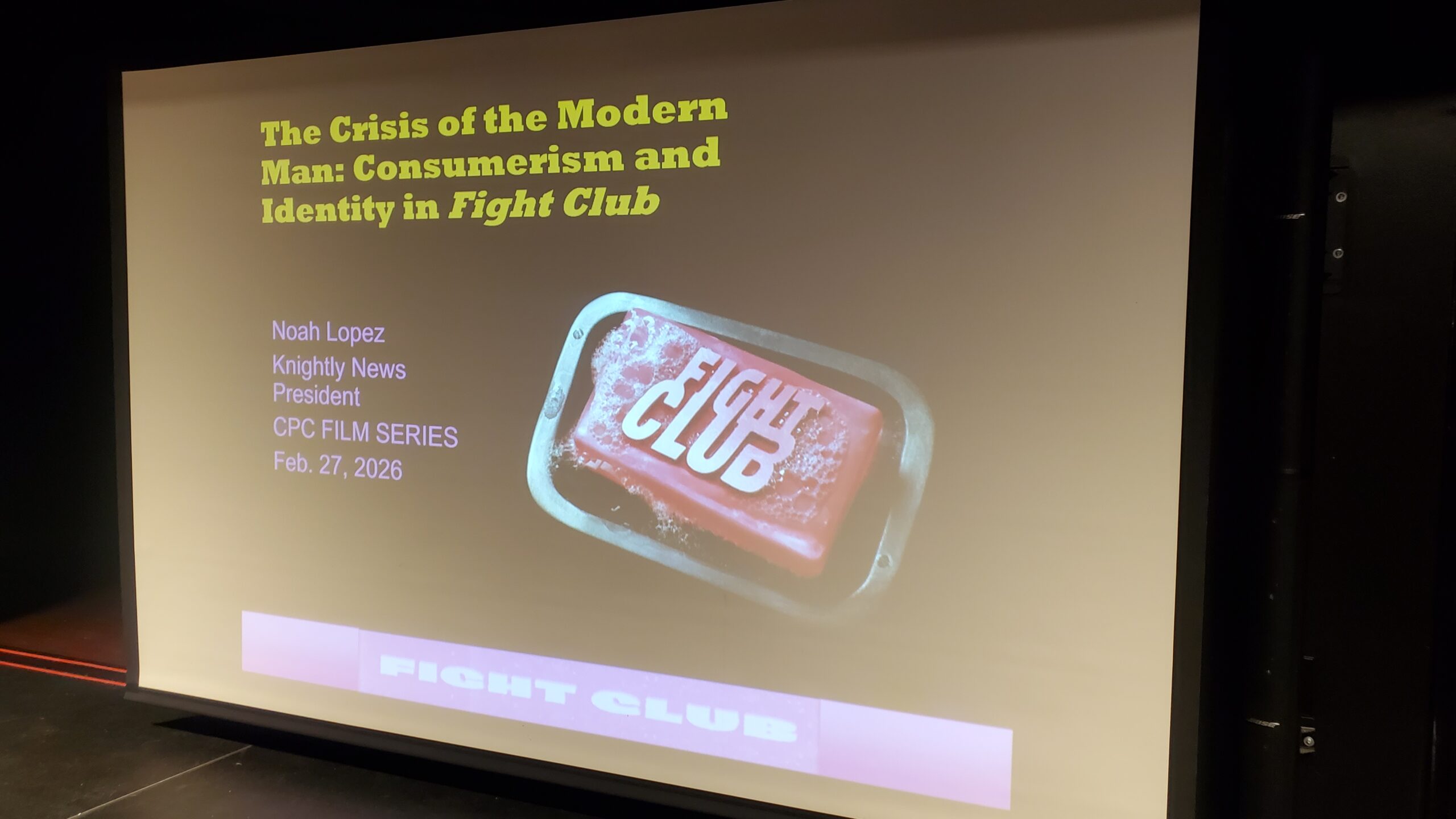
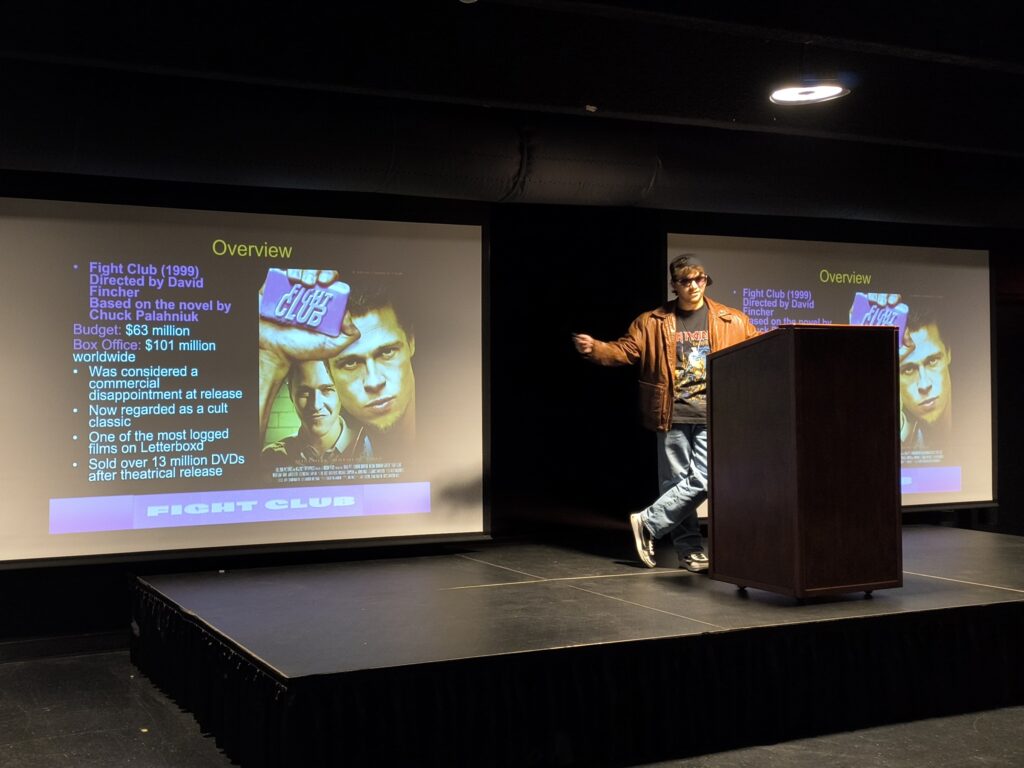
Knightly News Media Club President Noah Lopez took the stage to showcase the 1999 cult classic film. However, this was no ordinary screening, as “Fight Club” marked the 30th edition of the film series event.

Photo by Paul Miller
Meeting with the host
I sat down with Lopez before the presentation to discuss the cultural significance of the film, the commentary that “Fight Club” provides on the roles of men in modern society, and the impact that poor marketing had on the film’s success, or lack thereof, during its theatrical release.
Our discussion began with asking Lopez why he chose “Fight Club” for the night’s viewing. “I saw this movie for the first time in October of 2025, and it changed my outlook on the world,” stated Lopez, a very strong sentiment about the power of film.
During his presentation, Lopez explained how “Fight Club” is less about the fighting and more about making a commentary on the ways that materialism encourages conformity, how damaging emotional suppression can be, and the lengths people will go in order to find their place in this world. He explained how the film explores the ways that modern culture can pressure men into repressing their emotions, and how those attitudes have led to an internet subculture that glorifies a toxic relationship with masculinity.
In the promotion of the event, Lopez was a guest on the Knightly News Podcast, where he discussed much more about his experience with the film. The full episode can be found here.
The larger conversation
As Lopez concluded his presentation, the theatre was met with a startling scene. The film’s unnamed narrator is caught atop a skyscraper with a gun to his mouth. The scene quickly flashes back as the narrator begins to explain how he came to be in that situation.
At the beginning of the film, our narrator serves as a representation of the monotonous life of an office worker. His attitude conveys a sense of feeling insignificant, and he comes across as disassociated from the world around him. Despite being the main character of the film, his appearance is rather unremarkable. He appears as an archetype of a silently depressed office worker, and the film’s dull color scheme only adds to that melancholy feeling.
The unnamed narrator suffers from insomnia, which his doctor believes is caused by deeper emotional repression. As an outlet for his emotions, he begins attending support group meetings for diseases he does not have.
The narrator’s need to go to such extreme lengths just to feel some amount of emotional expression and validation speaks both to the overarching theme of “Fight Club” and to how much pressure many real men are under to conceal their feelings.
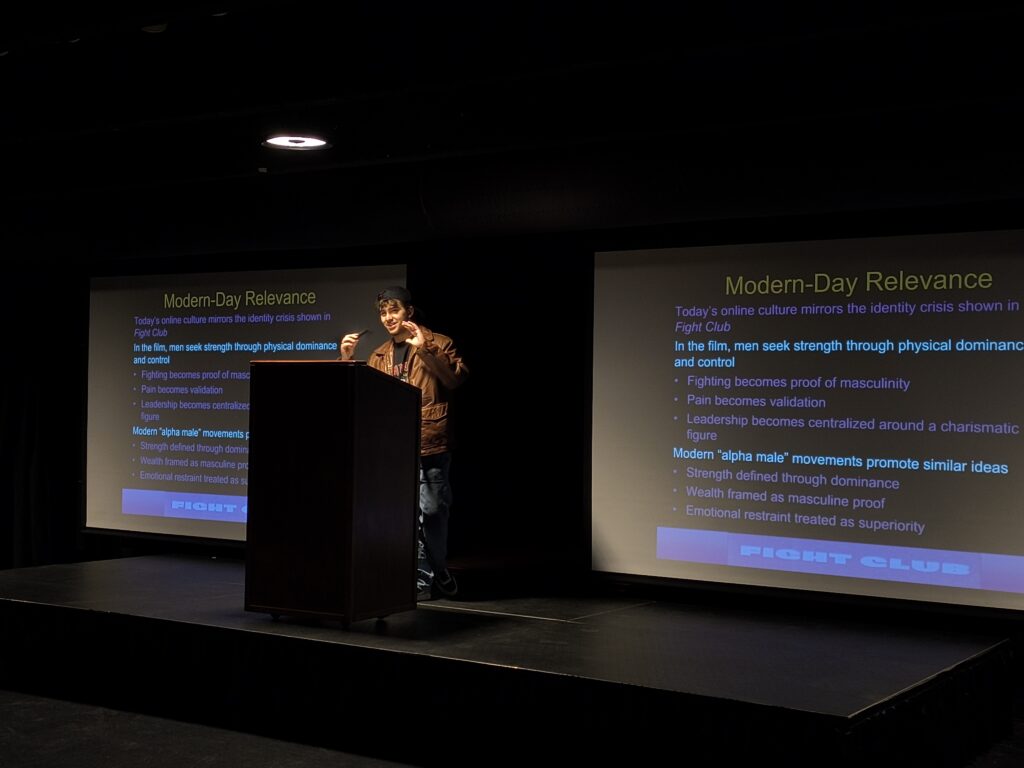
During the preshow interview, Lopez explained, “The film sparked a conversation about masculinity as a whole. At the time that ‘Fight Club’ came out, jobs were really shifting from hard labor to office jobs. Men had to make the shift… and I think that affected the mental state of a lot of men back then.”
During his presentation, Lopez talked about how this pressure has led to a rise in a subset of online influencers who promote unhealthy attitudes glorifying men’s emotional repression as an example of peak masculinity. These influencers equate emotional stoicism with strength and encourage men, especially young men, to be as traditionally masculine as possible. Lopez explained that this subset of influencers is referred to as “alpha males.”
“If you look around on the internet, especially right now in the 2020s, we are in an alpha male epidemic,” Lopez explained.
“The alpha male ideology thinks that men must be as strong, powerful, and emotionless as possible. The commentary from ‘Fight Club’ is still relevant today because those male insecurities still exist. That’s why men fall for that alpha male ideology.”
As the movie progresses, the unnamed narrator of “Fight Club” meets Tyler Durden while on a business trip. Durden is a charismatic soap salesman and critic of modern consumerism. Due to a sequence of unfortunate events, the narrator quickly finds himself moving in with Durden. Shortly after, the two men establish a secret underground fight club.
The mis-marketed movie
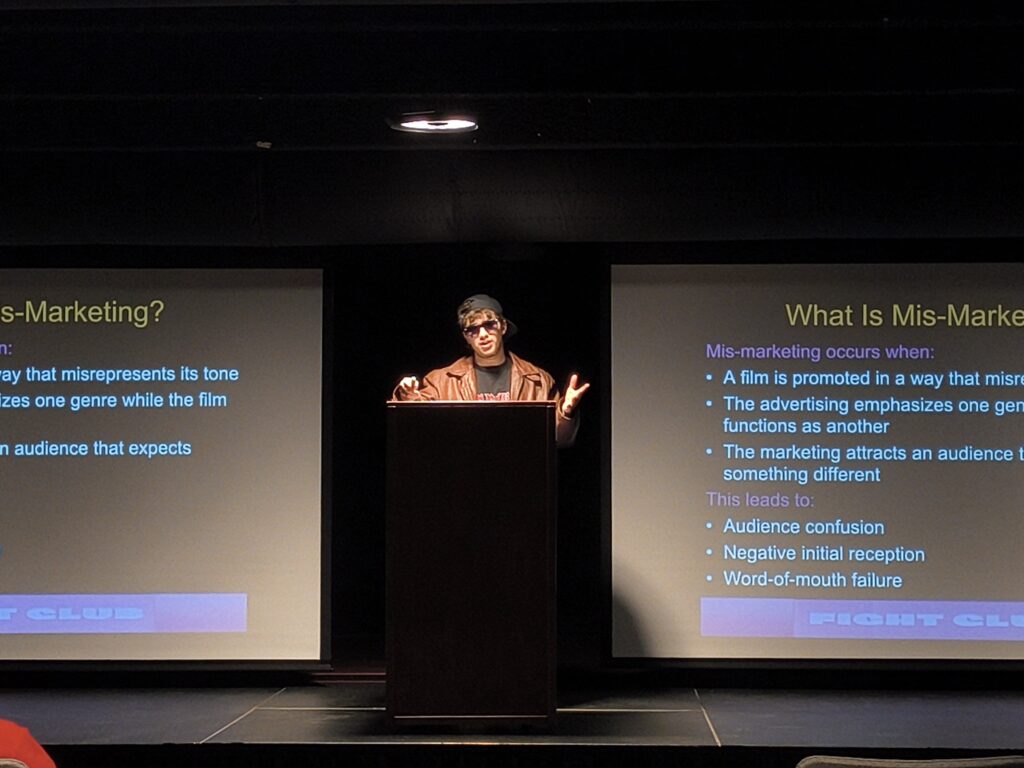
Although it is now regarded as a cult classic, “Fight Club” had a rather poor reception at the box office.
During his presentation, Lopez attributed this rocky beginning to mis-marketing by the movie studio. “The film was marketed as a fighting movie. It was marketed at WWF (now WWE) events, but the movie is more of a psychological movie than a fighting movie.”
Although the pre-release marketing misrepresented the nature of “Fight Club” to viewers, Lopez put a positive spin on the situation. “The mis-marketing drew in the people who were attracted to violent, overly masculine movies, and those were the type of people who needed to see this movie the most.”
Nearing the end of the pre-show interview, I asked Lopez what he hoped the audience would take away from this screening. Lopez explained that he hopes people leave the theater questioning the messaging of the movies they are watching. He hopes that viewers will take time to think a little deeper about films. Lopez concluded, “Hopefully people will walk away asking ‘what is the movie actually trying to say?’”
The CPC Film Series event was attended by about 30 people, many of whom had never actually seen the film before. Before the event, Lopez offered an arm wrestling tournament, where about eight students participated.
Alex Foley is the co-vice president of the Knightly News Media Club.
The CPC Film Series will return on May 29, with presenters Dylan Bowman and Nik Hogan presenting their own independent short films. More information will be released in the coming weeks.